BRAND
Hunkemöller
THE Integration
Workday and Outlook
THE Channels
WhatsApp and Voice
The Ecosystem
Scotty AI (orchestration) + Equalture (assessments)
The Footprint
180+ NL stores
In high-volume retail, the hiring process isn’t a back-office function. It’s a customer experience. Every candidate who applies to work in one of your stores is almost certainly a customer too, and how you treat them in that first interaction shapes how they feel about your brand. For Hunkemöller, Europe’s leading lingerie brand with 900+ stores across 19 countries, that experience had quietly stopped working.
According to Phenom’s 2025 State of High-Volume Hiring report (based on an audit of 101 companies) 88% of high-volume employers still rely on manual processes that can’t scale (Phenom, 2025). Hunkemöller recognised this early. Rather than patching an outdated process, they redesigned the whole candidate journey from scratch. Here’s what they built, and what it took.
In short Hunkemöller replaced a slow, video-first hiring process with Bowy, an AI recruiter built on Scotty AI that engages candidates on WhatsApp within seconds of applying. Results: time-to-hire dropped from 18 to 4 days, and game-based assessment completion rose above 80% (Hunkemöller × Scotty AI × Equalture, January 2026).
Why retail hiring breaks before candidates even walk through the door
Retail has a turnover problem most people underestimate. The Mercer 2025 US Turnover Survey (drawing on data from 2,617 organisations) found retail and wholesale voluntary turnover sits at 26.7%, more than double the national average of 13.0% (Mercer, 2025). That means most retailers are nearly always hiring. And if the process is too slow or too clunky, many candidates won’t finish it – 73% abandon applications that take longer than 15 minutes (Hays research via Harver, 2025).What the signals were telling Hunkemöller
For Hunkemöller, the signals were hard to miss. Video assessment completion rates had been declining for years, more and more candidates simply weren’t comfortable recording themselves. As a result, store managers were absorbing the fallout: manually screening CVs, chasing candidates for availability, coordinating interview slots across calendars, keeping communication organised across email, WhatsApp, and their ATS simultaneously. It wasn’t efficient. It wasn’t scalable. And it wasn’t reflecting the brand.“Over the past years, we saw clear signals that our hiring process no longer matched the expectations of our candidates, or the needs of our stores,” says Daphne Koning-Olde Dubbelink, Global Recruitment & Employer Branding Manager at Hunkemöller. “Add to that the high turnover in retail and the pressure on speed, and it became clear: we needed a future-ready process that was faster, fairer, and more engaging for candidates.”
Consequently, their response wasn’t to fix individual steps. It was to rebuild the entire journey around a different question: what should the first ten minutes feel like for someone who wants to work here?
Phenom’s 2025 State of High-Volume Hiring report found 68% of high-volume hiring companies rely on manual processes that struggle to scale, and only 20% of retail and hospitality companies allow candidates to self-schedule interviews automatically (Phenom, 2025). For Hunkemöller, operating 180+ stores in the Netherlands alone, the gap between what candidates expected and what the process delivered had become impossible to ignore.
Meet Bowy: Owning the first 10 minutes
At the centre of the new journey is Bowy, Hunkemöller’s AI recruiter, powered by Scotty AI. With 175 million people messaging a WhatsApp Business account daily (Meta/WhatsApp via Infobip, 2025), the design principle was clear: own the moment of interest on the channel candidates actually use. In retail, if you don’t engage within minutes of application, you’ve likely already lost them to a competitor down the street.
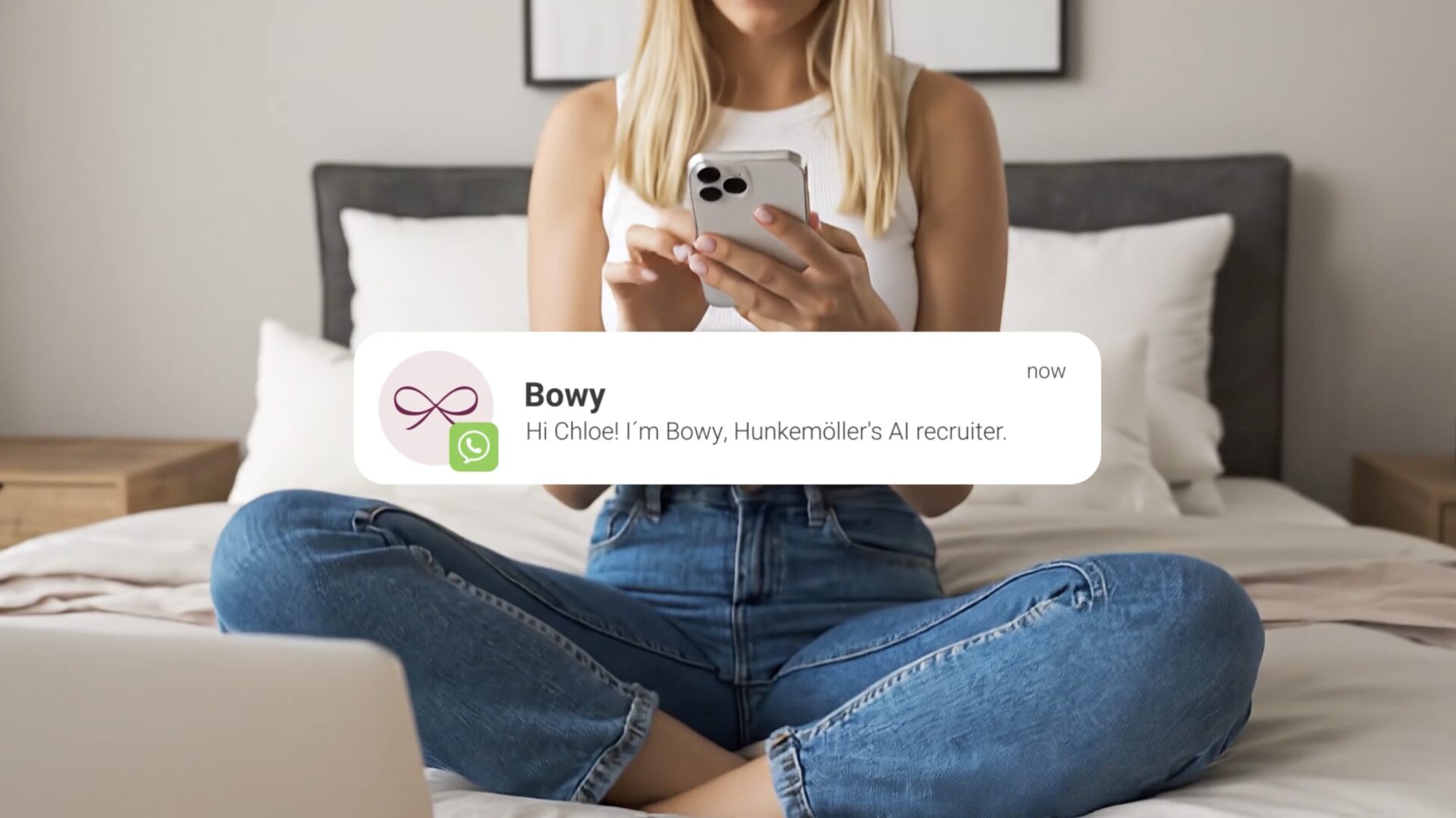
The second someone hits “apply” on the Hunkemöller career site, Bowy sends a WhatsApp message. Not an automated email three days later. A message, right now, on the channel they already use every day.
What should candidates feel in those first minutes? Daphne’s answer is specific.
“We want them to feel Welcomed. Empowered. Included. Inspired. And it should be a fun and playful experience. Those first ten minutes should already tell them: ‘Hunkemöller could be an interesting match from a cultural perspective and values my time as an applicant.’ With Bowy reaching out immediately and guiding candidates through the first steps, they experience a level of responsiveness and clarity that feels personal and genuine. There’s no more waiting or guessing — just a smooth, intuitive beginning to what we hope becomes a long relationship.”
That’s not a soft aspiration. It’s a set of design requirements. Bowy handles initial outreach, pre-screens via text or voice conversation, and keeps the process moving, without placing any of that coordination load on store managers. Every candidate, at every Hunkemöller store, gets the same quality of first experience. That consistency is itself a fairness mechanism.
Bowy, Hunkemöller’s AI recruiter powered by Scotty AI, engages candidates instantly via WhatsApp the moment they apply — 24 hours a day, 7 days a week across 180+ Dutch stores. It handles initial outreach, natural language pre-screening via text or voice, Equalture game-based assessments, and full interview scheduling, syncing all data to Workday in real time (Hunkemöller × Scotty AI × Equalture, January 2026).
Why whatsApp and games? The problem they actually aolved
Here’s the honest version: candidates weren’t completing the video assessments. 73% of applicants abandon applications that take longer than 15 minutes (Hays via Harver, 2025), and a multi-step video recording routinely exceeds that threshold. For frontline retail roles with high volumes and relentless turnover, that drop-off isn’t a minor inefficiency. It’s a structural problem that erodes your candidate pool before it even forms. “Our old process created friction,” Daphne explains. “Candidates no longer felt comfortable with the video assessments, and many simply didn’t complete them.”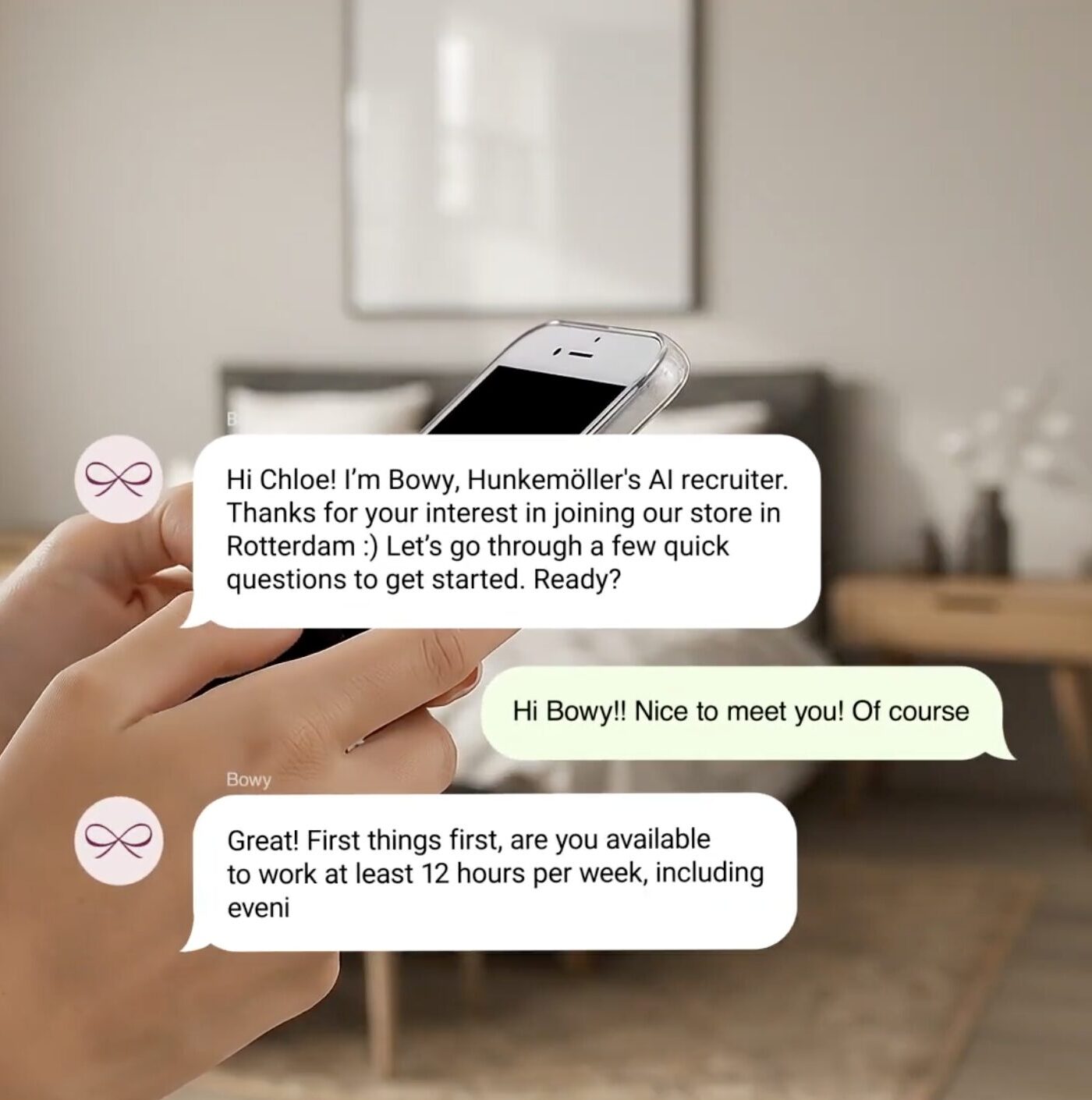
Together, two changes tackle the same root problem from different angles.
WhatsApp removes the barrier of channel mismatch. Most retail candidates are on their phones (between shifts or errands) when they apply. A WhatsApp conversation feels natural. Fast. Personal. An email telling them to log into a career portal doesn’t. Removing that mismatch isn’t a nice-to-have. It’s what drives completion.
Equalture’s game-based assessments replace the video recording entirely. Instead of asking candidates to perform on camera, the games measure role-relevant cognitive traits and behavioural patterns through structured play. In fact, the science is solid: a peer-reviewed study across 11,574 assessment completions found game-based cognitive assessments achieve convergent validity of r = 0.50 and test-retest reliability of r = 0.68 metrics comparable to traditional psychometric tools (Frontiers in Psychology / PMC, 2023). A 2025 follow-up study found real job applicants also showed significantly more favourable reactions to gamified assessments than to traditional tests in high-stakes settings (PMC, 2025).
The outcome at Hunkemöller? Assessment completion climbed to over 80%. Success profiles were built by letting existing top performers play the games first, so matching criteria reflect what actually predicts strong performance in a specific retail role, not what looks polished on a CV.
Before vs. After: Hunkemöller’s Hiring Journey
| Stage | The Old “Slog” | The New “Flow” |
|---|---|---|
| Initial contact | Days later via email | Seconds via WhatsApp |
| Screening | Manual CV review | AI pre-screening conversation |
| Assessment | One-way video recording | Game-based play (mobile-first) |
| Admin | Manual scheduling, chasing, follow-up | Zero recruitment admin |
Switching from one-way video to Equalture’s game-based assessments pushed Hunkemöller’s completion rate above 80%. A 2023 peer-reviewed study in Frontiers in Psychology found game-based cognitive assessments achieve convergent validity of r = 0.50 (n = 11,574) — statistically comparable to traditional aptitude tests, while delivering a significantly better candidate experience (PMC, 2023).
What zero recruitment admin looks like in practice
Only 20% of retail and hospitality companies allow candidates to self-schedule interviews automatically (Phenom, 2025). The other 80% rely on humans to handle every handoff — and at Hunkemöller, that meant store managers manually screening CVs, chasing candidates for availability, coordinating interview slots, and keeping communication organised across email, WhatsApp, and their ATS simultaneously. Work that ate hours. Every week. Across 180+ stores.
That’s the part most automation tools don’t actually solve. They handle the candidate-facing conversation but leave the coordination to humans. Bowy does the full loop.
Once the game assessment is complete, Bowy takes the results, updates Workday in real time, schedules the interview (syncing with Outlook calendars), sends reminders, and handles rescheduling. All automatically. No manual handoff. No admin backlog. The only time a human gets involved is when there’s a genuine decision to make.
Rianne Jellema, Head of Customer Success at Scotty AI, puts it plainly:
“In high-volume retail, the challenge isn’t just the conversation, it’s the operations behind it. Systems often don’t talk to each other, and store managers don’t have time to chase candidates. Scotty AI enables Bowy to not just chat, but to act: syncing with calendars and systems of record to keep the process moving end-to-end.”
The results: From 18 days to 4
Time-to-hire at Hunkemöller dropped from 18 days to 4 days after the launch. That’s not a marginal improvement, it’s structural. The retail industry average currently sits at 24.6 days (DHI Hiring Indicators via Fountain, 2025). Hunkemöller is now operating at a fraction of that baseline. What does that difference actually mean for a brand running 180+ stores?
In practice, it means a candidate who applies on a Monday can be hired by Friday. It means store managers aren’t waiting days for qualified candidates to move through a process that stalls at every manual handoff. And it means the best candidates (the ones with options) don’t have time to accept another offer while Hunkemöller’s inbox catches up.
“Speed is the biggest operational win,” Daphne says. “But it’s speed without compromising quality. We’re giving time back to our teams so they can focus on their people.”
Importantly, that last part matters. The goal of this automation isn’t to remove humans from hiring. It’s to remove humans from the manual coordination that stops them from doing the genuinely human work: making sound decisions, building relationships, and running excellent stores.
Following the January 2026 launch of Bowy, time-to-hire across Hunkemöller’s Dutch store network dropped from 18 days to 4 days, compared to a retail industry average of 24.6 days (DHI Hiring Indicators, 2025). Game-based assessment completion simultaneously rose above 80%, replacing a video format with markedly lower completion rates. Both metrics reflect the January 2026 rollout across 180+ stores in the Netherlands (Hunkemöller × Scotty AI × Equalture, 2026).
What “fair and future-ready” actually means at Hunkemöller
Speed gets the headline. But with retail voluntary turnover at 26.7%, more than double the national average of 13.0% (Mercer, 2025) improving match quality at the point of hire matters just as much as shaving days off the process. Daphne returns to fairness consistently, and it’s worth understanding why, because it addresses something most recruitment technology misses entirely.
Why CVs fall short for frontline retail roles
The problem with CV-based screening isn’t just unconscious bias, though that’s real. It’s that CVs are a poor signal of role fit for frontline retail positions. They reward candidates who know how to write a CV, not candidates who stay calm under pressure, build rapport quickly with customers, or hold together a fast-moving team on a Saturday afternoon.
“Fairness means every candidate (no matter their background, region, or experience) gets an equal, objective, and respectful hiring process. Not just in theory, but in every step,” Daphne explains. “Future-ready means embracing technology that helps us do this at scale: science-based assessments, automation, AI-driven communication, and consistent global standards. It’s a way of hiring that reflects our brand.”
Equalture’s game-based format cuts several common bias sources: presentation style, written language fluency, CV polish. It measures cognitive potential and role-relevant behavioural traits instead. And because success profiles are built by letting actual top performers play the games first, the matching criteria reflect what genuinely predicts strong performance in a specific Hunkemöller role, not what looks impressive on paper.
Ultimately, the long-term bet is quality-of-hire and retention. “When we hire people whose natural strengths match the job, they perform better, stay longer, and develop faster,” Daphne says. In a sector where turnover is a chronic challenge (and where every mis-hire adds to the recruitment cycle that already consumes enormous time) improving fit at the point of hire is one of the highest-leverage investments a retail brand can make.
What other retail brands can take from this
Hunkemöller’s starting situation isn’t unusual, 68% of high-volume employers still rely on manual hiring processes that can’t scale (Phenom, 2025). High application volumes, candidates dropping off, store managers overwhelmed with coordination: this describes most large retail TA operations. What’s different here is the decision to fix the structure, not patch the symptoms. The pattern holds across Scotty AI’s client base: PostNL achieved 91% candidate satisfaction after switching to AI-powered high-volume hiring, and Actief Werkt reached a 4.6-star candidate experience rating using the same approach.
A few things stand out for any retail TA leader thinking about this:
The channel matters more than the technology.
WhatsApp works because that’s where most retail candidates already spend time. Pushing them into a portal they don’t use is friction by design (regardless of what’s inside the portal). Meet candidates where they are, or accept that many won’t complete the journey.
Automation without integration is half a solution.
Moreover, Bowy’s operational value isn’t just that it talks to candidates. It’s that it talks to Workday, syncs with Outlook, and executes scheduling without anyone manually bridging those systems. The orchestration layer (connecting conversation to action in systems of record) is what makes zero recruitment admin achievable. Without it, you’ve just moved the manual work from one person to another.
Science-based assessment matters more for frontline roles, not less.
Game-based assessments are a more valid, more inclusive way to measure role-relevant potential, especially for positions where CVs are a weak predictor of job success. The peer-reviewed data supports this. Hunkemöller’s 80%+ completion rate confirms it works in practice too.
Frequently asked questions
Questions we often hear about how Hunkemöller built its AI hiring process
Bowy is Hunkemöller's AI recruiter, built on Scotty AI's orchestration platform. The moment a candidate applies, Bowy contacts them via WhatsApp — through text or voice — and runs a natural language pre-screening conversation. It then guides them through Equalture's game-based assessment and automatically schedules their interview, syncing all results to Workday in real time. Store teams don't need to get involved until the interview itself.
WhatsApp is where most retail candidates already spend time on their phones. A response within seconds on a familiar, mobile-first app feels respectful and personal — which is exactly what Hunkemöller wanted the first interaction to feel like. Email follow-ups can take days; WhatsApp engagement is immediate. This shift directly reduced candidate drop-off during the critical first-contact window, where losing applicants is most costly.
Equalture's game-based assessments measure cognitive potential and role-relevant behavioural traits through structured play — rather than self-recorded video or CV review. A 2023 peer-reviewed study across 11,574 completions found these assessments achieve convergent validity of r = 0.50 and test-retest reliability of r = 0.68. Hunkemöller's assessment completion rates rose above 80% after switching from video — a significant jump from prior performance.
Following the January 2026 launch, time-to-hire dropped from 18 days to 4 days — well below the retail industry average of 24.6 days. Game-based assessment completion exceeded 80%. Store teams also recovered significant hours previously spent on manual coordination: screening applications, scheduling interviews, chasing candidates, and updating records across Workday and Outlook.
Yes. Scotty AI's platform is built for enterprise-scale, multi-location deployment across systems and channels. The Hunkemöller rollout covers 180+ stores in the Netherlands and integrates Workday, Outlook, and WhatsApp with consistent process standards across locations. Hunkemöller itself operates 900+ stores across 19 countries, and the architecture is designed to scale beyond the initial market.
If you’re evaluating a similar transformation for your retail hiring process, you can Book a demo with Scotty AI to see how Bowy works in practice.